


.png)

 ( 母液浓度为 40 mg/mL ), 如您需要配置的浓度超过该产品的溶解度,请先与我们客服联系。
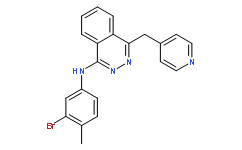
| 中文名称: | NVP-ACC789 一键复制产品信息 | ||||
|---|---|---|---|---|---|
| 英文名称: | NVP-ACC789 | ||||
| 别名: | N-(3-溴-4-甲基苯基)-4-(吡啶-4-基甲基)酞嗪-1-胺 N-(3-Bromo-4-methylphenyl)-4-(pyridin-4-ylmethyl)phthalazin-1-amine | ||||
| CAS No: | 300842-64-2 | 分子式: | C21H17BrN4 | 分子量: | 405.299 |
| CAS No: | 300842-64-2 | ||||
| 分子式: | C21H17BrN4 | ||||
| 分子量: | 405.299 | ||||
包装规格:
5mg 10mg 25mg 50mg in glass bottle
溶解性:
溶于DMSO(25mg/mL超声)
产品描述:
基本信息
|
产品编号:N11191 |
|||||
|
产品名称:NVP-ACC789 |
|||||
|
CAS: |
300842-64-2 |
储存条件 |
粉末 |
-20℃ |
四年 |
|
|
|
||||
|
分子式: |
溶于液体 |
-80℃ |
六个月 |
||
|
分子量 |
405.30 |
-20℃ |
一个月 |
||
|
化学名: |
|
||||
|
Solubility (25°C) |
体外 |
DMSO |
|
||
|
Ethanol |
|
||||
|
Water |
|
||||
|
体内(现配现用) |
|
|
|||
|
<1mg/ml表示微溶或不溶。 |
|||||
|
普西唐提供的所有化合物浓度为内部测试所得,实际溶液度可能与公布值有所偏差,属于正常的批间细微差异现象。 |
|||||
|
请根据产品在不同溶剂中的溶解度选择合适的溶剂配制储备液;⼀旦配成溶液,请分装保存,避免反复冻融造成的产品失效。 |
|||||
制备储备液
|
浓度
溶液体积 质量 |
1mg |
5mg |
10mg |
|
1mM |
2.4674mL |
12.3368mL |
24.6737mL |
|
5mM |
0.4935mL |
2.4674mL |
4.9347mL |
|
10mM |
0.2467mL |
1.2337mL |
2.4674mL |
生物活性
|
产品描述 |
一种人 VEGFR-1,VEGFR-2 (鼠 VEGFR-2),VEGFR-3 和 PDGFR-β 的抑制剂,IC50 值分别为 0.38,0.02 (0.23),0.18 和 1.4μM。 |
|||
|
靶点/IC50 |
VEGFR-2 0.02μM (IC50) |
VEGFR-1 0.38μM (IC50) |
mVEGFR-2 0.23μM (IC50) |
VEGFR-3 0.18μM (IC50) |
|
PDGFR-β 1.4μM (IC50) |
|
|
|
|
|
体外研究 |
The enzymatic kinase assays demonstrate that NVP-ACC789 is an inhibitor of human VEGFR-1, VEGFR-2 (mouse VEGFR-2), VEGFR-3 and PDGFR-β with IC50s of 0.38, 0.02 (0.23), 0.18, 1.4μM,respectively. In VEGF-treated cultures, addition of the VEGFR-2 inhibitor NVP-ACC789 reduces BME cell number to baseline levels from 1μM. Likewise, bFGF-induced BME cell proliferation is reduced markedly by NVP-ACC789 from 1 to 10μM, without however reaching basal levels. NVP-ACC789 is found to be a potent inhibitor of VEGF-induced HUVE cell proliferation with an IC50 of 1.6nM. NVP-ACC789 also completely inhibits VEGF-induced BME and BAE cell invasion and VEGF-C-induced BAE cell invasion. The inhibition is dose-dependent in both cell types with a maximal effect from 1μM. |
|||
|
体内研究 |
NVP-ACC789 which is given in daily oral doses for 6 days blocks VEGF-induced angiogenesis in a dose-dependent manner. NVP-ACC789 also inhibits the response to bFGF to some extent, but the dose-response curve is not linear for NVP-ACC789. |
|||
推荐实验方法(仅供参考)
|
激酶实验: |
|
Human VEGFR-2-transfected CHO cells are seeded into 6-well plates and grown to about 80% confluency. NVP-ACC789 is added in serial dilutions and the cells incubated for 2h at 37°C in medium without fetal calf serum (FCS). VEGF (20ng/mL) is then added. After a 5-min incubation at 37°C, the cells are washed twice with ice-cold phosphate-buffered saline and lysed. Nuclei are removed by centrifugation for 10 min at 4°C. Protein concentrations of the lysates are determined. |
|
细胞实验: |
|
|
HUVE cell proliferation is determined. Cells are seeded into 1.5% gelatin-coated 96-well plates (5×10³ cells per well) and incubated in endothelial cell growth medium containing 5% fetal calf serum (FCS) for 24h. The medium is replaced with essential basic medium (1.5% FCS), and the cells are incubated for another 24 h. Essential basic medium is then replaced with fresh medium containing either 50ng/mL VEGF or 0.5ng/mL bFGF. NVP-ACC789 is added just before addition of growth factors. The cells are incubated for a further 24h before adding the BrdU labeling solution. Twenty four hours later, the labeling solution is removed, the cells are fixed, and the incorporated BrdU is visualized with a peroxidase-labeled anti-BrdU antibody and TMB substrate. |
|
|
动物实验: |
|
|
Porous Teflon chambers (volume, 0.5mL) filled with 0.8% w/v agar-containing heparin (20U/mL) with or without VEGF (2μg/mL) or bFGF (0.3μg/mL) are implanted subcutaneously on the dorsal flank of female mice. The mice are treated with NVPACC789 (p.o. once daily) or vehicle (5% dimethyl sulfoxide,1% Tween 80 in water) starting 1 day before implantation of the chamber and continuing for 5 days thereafter.At the end of the treatment period, the mice are killed,and the chambers are removed.The vascularized tissue growing around the chamber is removed carefully and weighed,and the blood content is assessed by measuring hemoglobin levels.The percentage inhibition of the angiogenic response (increase in tissue weight or total blood) is calculated.EC50 values are estimated from the dose response curves (% inhibition versus dose).Each experiment is performed with six animals per dose group and each dose is tested in at least two independent experiments. |
|
保存条件:
-20℃
UN码:
HazardClass:
危害声明:
安全说明:
搜索质检报告(COA)
本计算器可帮助您计算出特定溶液中溶质的质量、溶液浓度和体积之间的关系,公式为:
质量 (g) = 浓度 (mol/L) x 体积 (L) x 分子量 (g/mol)
摩尔浓度计算公式
用本工具协助配置特定浓度的溶液,使用的计算公式为:
开始浓度 x 开始体积 = 最终浓度 x 最终体积
稀释公式
稀释公式一般简略地表示为:C1V1 = C2V2 ( 输入 输出 )
(2).jpg)
体内配方的制备方法: 取 50μLDMSO 母液,添加 300 μLPEG300 混匀澄清,再加 50μLTween80, 混匀澄清,再加 600μLSaline/PBS/ddH2O 混匀澄清
方案所需的各种助溶剂如: DMSO , PEG300 / PEG400 , Tween 80 , SBE-β-CD , 玉米油 等, 均可点击跳转或在网站搜索购买。
母液,添加 300 μLPEG300 混匀澄清,再加 50μLTween80, 混匀澄清,再加 600μLSaline/PBS/ddH2O 混匀澄清方案所需的各种助溶剂如: DMSO , PEG300 / PEG400 , Tween 80 , SBE-β-CD , 玉米油 等, 均可点击跳转或在网站搜索购买。
以上为“动物实验计算换算器”的使用方法举例,并不是具体某个试剂的配制,请根据您的实验动物和给药方式选择适当的溶解方案。
计算结果:
工作液浓度: mg/ml;
DMSO母液配制方法: mg 药物溶于 μL DMSO溶液(母液浓度 mg/mL,
体内配方配制方法:取 μL DMSO母液,加入 μL PEG300,混匀澄清后加入μL Tween 80,混匀澄清后加入 μL Saline/PBS/ddH2O,混匀澄清。
1. 首先保证母液是澄清的;
2.
一定要按照顺序依次将溶剂加入,进行下一步操作之前必须保证上一步操作得到的是澄清的溶液,可采用涡旋、超声或水浴加热等物理方法助溶。
剂量转换
对于不同动物的给药剂量换算,您也可以参考 更多


