

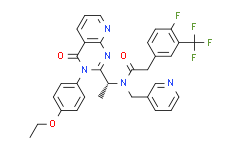
.png)

 ( 母液浓度为 40 mg/mL ), 如您需要配置的浓度超过该产品的溶解度,请先与我们客服联系。
| 中文名称: | NBI-74330 一键复制产品信息 | ||||
|---|---|---|---|---|---|
| 英文名称: | NBI-74330 | ||||
| 别名: | N-[(1R)-1-[3-(4-乙氧基苯基)-3,4-二氢-4-氧代吡啶并[2,3-D]嘧啶-2-基]乙基]-4-氟-N-(3-吡啶基甲基)-3-(三氟甲基)苯乙酰胺 N-{1-[3-(4-Ethoxyphenyl)-4-oxo-3,4-dihydropyrido[2,3-d]pyrimidin- 2-yl]ethyl}-2-[4-fluoro-3-(trifluoromethyl)phenyl]-N-(3-pyridinyl methyl)acetamide;NBI 74330 | ||||
| CAS No: | 855527-92-3 | 分子式: | C32H27F4N5O3 | 分子量: | 605.58 |
| CAS No: | 855527-92-3 | ||||
| 分子式: | C32H27F4N5O3 | ||||
| 分子量: | 605.58 | ||||
包装规格:
1mg 5mg 10mg 25mg in glass bottle
溶解性:
溶于DMSO(100mg/mL 超声)
产品描述:
基本信息
|
产品编号: |
N10716 |
||||
|
产品名称: |
NBI-74330 |
||||
|
CAS: |
855527-92-3 |
储存条件 |
粉末 |
-20℃ |
四年 |
|
|
|
||||
|
分子式: |
溶于液体 |
-80℃ |
6个月 |
||
|
分子量: |
605.58 |
-20℃ |
1个月 |
||
|
化学名: |
N-{1-[3-(4-Ethoxyphenyl)-4-oxo-3,4-dihydropyrido[2,3-d]pyrimidin-2-yl]ethyl}-2-[4-fluoro-3-(trifluoromethyl)phenyl]-N-(3-pyridinyl methyl)acetamide |
||||
|
Solubility (25°C): |
|||||
|
体外:
|
DMSO |
|
|||
|
Ethanol |
|
||||
|
Water |
|
||||
|
体内(现配现用): |
|
||||
|
<1mg/ml表示微溶或不溶。 |
|||||
|
普西唐提供的所有化合物浓度为内部测试所得,实际溶液度可能与公布值有所偏差,属于正常的批间细微差异现象。 |
|||||
|
请根据产品在不同溶剂中的溶解度选择合适的溶剂配制储备液;⼀旦配成溶液,请分装保存,避免反复冻融造成的产品失效。 |
|||||
制备储备液
|
浓度
溶液体积 质量 |
1mg |
5mg |
10mg |
|
1mM |
1.6513mL |
8.2565mL |
16.5131mL |
|
5mM |
0.3303mL |
1.6513mL |
3.3026mL |
|
10mM |
0.1651mL |
0.8257mL |
1.6513mL |
生物活性
|
产品描述 |
一种有效的 CXCR3 拮抗剂,能够抑制 (125I)CXCL10 和 (125I)CXCL11 的特异性结合,Ki 值分别为 1.5 和 3.2nM。 |
|
|
靶点 |
125I]CXCL10-CXCR3 1.5nM (Ki,in CXCR3-CHO cell membranes) |
[125I]CXCL11-CXCR3 3.2nM (Ki,in CXCR3-CHO cell membranes) |
|
体外研究 |
BI-74330 demonstrates potent inhibition of [125I]CXCL11 specific binding to membranes prepared from transfected CHO cells expressing CXCR3 (CXCR3-CHO) (Ki=3.6nM).NBI-74330 is 12- and 3.5-fold more potent than CXCL9 (Ki=45.2nM) and CXCL10 (Ki=12.5nM),respectively,at inhibiting [125I]CXCL11 binding to CXCR3-CHO cell membranes.NBI-74330 inhibits calcium mobilization in response to CXCL11 and CXCL10 with an IC50 value of 7nM for both ligands used at their EC80 concentrations (1nM for CXCL11 and 30nM for CXCL10).NBI-74330 specifically inhibits CXCR3-mediated calcium mobilization.NBI-74330 also dose-dependently inhibits CXCL11-induced [35S]GTPγS binding in membranes of cells endogenously expressing CXCR3 (H9 cells,IC50 value 5.5nM).BI-74330 inhibits CXCL11-induced chemotaxis in these cells with an IC50 of 3.9nM.BI-74330 (30-300nm,1-10μM) produces concentration-dependent,parallel rightward shifts of the CXCL11 E/[A] curve with no significant change in the E/[A] curve maximal response. |
|
|
体内研究 |
NBI-74330 (100mg/kg) results in the formation of an N-oxide metabolite,also an antagonist of CXCR3,in mice.Mice treated with 100mg/kg NBI-74330 (in 1% Na Doc in 0.5% 400Cp Methylcellulose) result in serum concentrations of approximately 1μM.This concentration is sufficient to fully block the CXCR3 receptor in vivo. |
|
推荐实验方法(仅供参考)
|
激酶实验: |
|
Cell membrane fractions are resuspended in 50mM HEPES,10mM MgCl2,100mM NaCl,and 1mM CaCl2,pH 7.2 for use in competitive radioligand binding reactions.Reactions are performed in duplicate and consisted of 25-μL unlabeled chemokine at indicated concentrations,25-μL radiolabeled chemokine ligand (appr 70nM;[125I]CXCL11 and [125I]CXCL10 with specific activities of 1500 and 2200 Ci/mmol,respectively;Fifty-μL membrane protein (5μg) are added sequentially in assay buffer (50mM HEPES,10mM MgCl2,100mM NaCl,1mM CaCl2,and 0.1% BSA,pH 7.2) to low-binding 96-well plates.The reaction is allowed to reach equilibrium by incubation at room temperature for 45 min while shaking.The amount of bound radioligand is determined by harvesting membranes via filtration through a UniFilter GF/C filter plate using a UniFilter-96 vacuum manifold (filters are pretreated with 1% polyethylenimine), washing twice with 400-μL wash buffer (10mM HEPES,5mM MgCl2,1mM CaCl2,and 500mM NaCl,pH 7.3),and measuring radioactivity by liquid scintillation using a TopCount NXT.The dissociation half-life of [125I]CXCL11 is measured using CXCR3-CHO membranes that are allowed to equilibrate with radiolabel (appr 70nM) for 30 min prior to the addition of excess cold CXCL11 (31nM final) in the presence or absence of different concentrations of NBI-74330.Membrane-bound [125I]CXCL11 is assessed in duplicate along with nonspecific binding ([125I]CXCL11 plus excess cold CXCL11 added at the same) and total binding ([125I]CXCL11 without inhibitors) at each time point on the same plate. |
|
动物实验: |
|
|
Female LDLr−/−mice,10 weeks old (n=8 to 12 per group),are fed a Western-type diet containing 0.25% cholesterol and 15% cocoa butter 2 weeks before collar placement.20 Mice are treated with a subcutaneous injection of 100mg/kg NBI-74330 every day during the entire experiment.After 8 weeks of Western-type diet and treatment,the mice are euthanized and organs are harvested for histology,fluorescence-activated-cell sorter (FACS) analysis,and RNA isolation.Blood samples are collected by tail bleeding from nonfasted animals,and concentrations of serum cholesterol and triglycerides are determined using enzymatic colorimetric procedures. |
|
保存条件:
-20℃
UN码:
HazardClass:
危害声明:
安全说明:
搜索质检报告(COA)
本计算器可帮助您计算出特定溶液中溶质的质量、溶液浓度和体积之间的关系,公式为:
质量 (g) = 浓度 (mol/L) x 体积 (L) x 分子量 (g/mol)
摩尔浓度计算公式
用本工具协助配置特定浓度的溶液,使用的计算公式为:
开始浓度 x 开始体积 = 最终浓度 x 最终体积
稀释公式
稀释公式一般简略地表示为:C1V1 = C2V2 ( 输入 输出 )
(2).jpg)
体内配方的制备方法: 取 50μLDMSO 母液,添加 300 μLPEG300 混匀澄清,再加 50μLTween80, 混匀澄清,再加 600μLSaline/PBS/ddH2O 混匀澄清
方案所需的各种助溶剂如: DMSO , PEG300 / PEG400 , Tween 80 , SBE-β-CD , 玉米油 等, 均可点击跳转或在网站搜索购买。
母液,添加 300 μLPEG300 混匀澄清,再加 50μLTween80, 混匀澄清,再加 600μLSaline/PBS/ddH2O 混匀澄清方案所需的各种助溶剂如: DMSO , PEG300 / PEG400 , Tween 80 , SBE-β-CD , 玉米油 等, 均可点击跳转或在网站搜索购买。
以上为“动物实验计算换算器”的使用方法举例,并不是具体某个试剂的配制,请根据您的实验动物和给药方式选择适当的溶解方案。
计算结果:
工作液浓度: mg/ml;
DMSO母液配制方法: mg 药物溶于 μL DMSO溶液(母液浓度 mg/mL,
体内配方配制方法:取 μL DMSO母液,加入 μL PEG300,混匀澄清后加入μL Tween 80,混匀澄清后加入 μL Saline/PBS/ddH2O,混匀澄清。
1. 首先保证母液是澄清的;
2.
一定要按照顺序依次将溶剂加入,进行下一步操作之前必须保证上一步操作得到的是澄清的溶液,可采用涡旋、超声或水浴加热等物理方法助溶。
剂量转换
对于不同动物的给药剂量换算,您也可以参考 更多


