

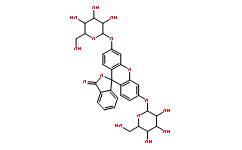
| 中文名称: | 荧光素-二-β-D-吡喃半乳糖苷 一键复制产品信息 | ||||
|---|---|---|---|---|---|
| 英文名称: | Fluorescein di-β-D-galactopyranoside | ||||
| 别名: | 荧光素-二-β-D-吡喃半乳糖苷 FDG | ||||
| CAS No: | 17817-20-8 | 分子式: | C32H32O15 | 分子量: | 656.59 |
| CAS No: | 17817-20-8 | ||||
| 分子式: | C32H32O15 | ||||
| 分子量: | 656.59 | ||||
| MDL: | MFCD00077344 | ||||

基本信息
|
产品编号: |
F10147 |
||||
|
产品名称: |
Fluorescein di-β-D-galactopyranoside |
||||
|
CAS: |
17817-20-8 |
储存条件 |
粉末 |
-20℃ |
四年 |
|
|
|
||||
|
分子式: |
溶于液体 |
|
|
||
|
分子量 |
656.59 |
|
|
||
|
化学名: |
|||||
生物活性
|
产品描述 |
Fluorescein di(β-D-galactopyranoside) 是 β-半乳糖苷酶的荧光底物 (λex=485nm,λem=535nm)。 |
|
靶点 |
|
|
体外研究 |
The fluorescence produced by Fluorescein di(β-D-galactopyranoside) increases in a time- and dose-dependent manner. The level of fluorescence produced by the double-substrate method is much lower than that by the Fluorescein di(β-Dgalactopyranoside) method. Results show that the fluorescein produced by Fluorescein di(β-D-galactopyranoside) in Hs68 cells is proportional to the number of passages |
推荐实验方法(仅供参考)
|
Cell Assay |
The cells (5×10³ cells per well) are cultured in a 96-well plate overnight for attachment, washed, and then fixed in solutions. An aliquot (100μL) of the reaction buffer (i.e., the staining solution without X-Gal) is added into each well. Then, 10μL of 2mM Fluorescein di(β-D-galactopyranoside) is added per well and the plate is incubated in the dark at 37°C for 24 h without CO2 supply. After incubation at 37°C for 24 h, 100μL of the supernatant is transferred to a 96-well plate for fluorescent measurement in triplicates. The fluorescein fluorescence is measured using a fluorometer with an excitation at 485nm and an emission at 535nm |
本计算器可帮助您计算出特定溶液中溶质的质量、溶液浓度和体积之间的关系,公式为:
质量 (g) = 浓度 (mol/L) x 体积 (L) x 分子量 (g/mol)
摩尔浓度计算公式
用本工具协助配置特定浓度的溶液,使用的计算公式为:
开始浓度 x 开始体积 = 最终浓度 x 最终体积
稀释公式
稀释公式一般简略地表示为:C1V1 = C2V2 ( 输入 输出 )


